Fabric Knowledge
Openness Factor, Light and UV: What a Screen Does
A 5% open weave transmits light and UV through its openings. Here is what openness factor does and does not control, why colour changes the numbers, and why a dark screen does not mean a cooler room.
Three words that get used as if they were one
Sunscreen fabric, blackout fabric and UV-blocking fabric are sold as if they were the same product. They are not, and confusing them is the most common reason a buyer ends up disappointed after installation.
Term | What it actually means | What decides it |
|---|---|---|
Sunscreen fabric | Reduces glare and solar heat while keeping some view and daylight | Openness factor, yarn colour, coating |
Blackout fabric | Blocks essentially all light | Zero openness, opaque coating or a separate liner |
UV-blocking fabric | Reduces ultraviolet transmission to a stated measured level | Measured UV transmittance of that exact colour |
A woven sunscreen with an openness factor of 5% is the first kind. It is not a blackout fabric, and it is not automatically a UV-blocking fabric in the certified sense.
Why an open weave must transmit light
Openness factor is geometry. A 5% fabric leaves roughly 5% of its surface as holes between the yarns. Light that reaches those holes is not absorbed and is not reflected: it passes through. That is the whole point of the weave, because those openings are what let you see out.
The practical consequence is simple arithmetic. If about 5% of the area is open, then a screen in direct sun transmits light in the same order of magnitude as its openness factor. No coating, certification or marketing phrase changes that, because the openings are the product.
UV behaves the same way. Ultraviolet radiation travels through the same holes as visible light. Yarn colour and coating decide how much of the rest is absorbed, so the measured UV transmittance of a 5% open fabric typically lands in the low single digits to low teens as a percentage, depending on the colour.
So why do some fabric pages claim 99% UV blocking?
Because a percentage of blocking is simply one minus a percentage of transmission, and transmission is small when the openings are small. Push the openness factor towards zero and the blocking figure rises towards 100%. The claim describes the weave, not a technology.
That does not make the claim false, but it does make it misleading as a comparison. A fabric with a lower openness factor will always show a higher blocking percentage, whatever its yarn and coating are made of. The number says more about how closed the fabric is than about how it was engineered.
The part almost nobody tells a buyer: colour changes the numbers
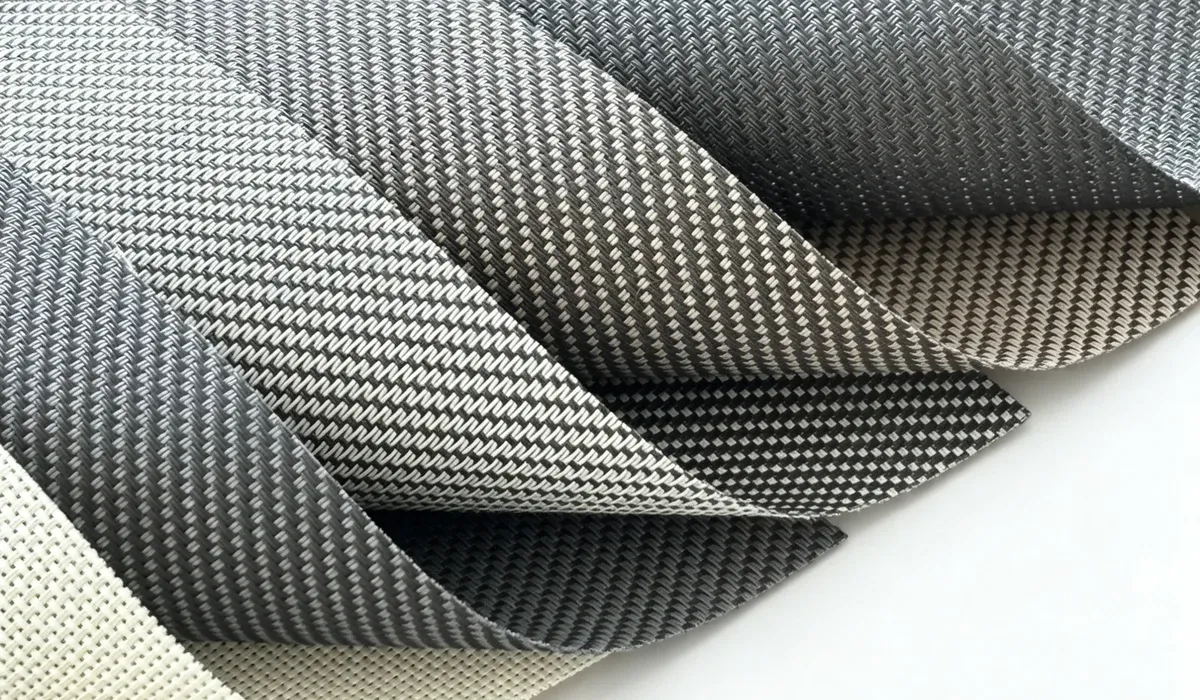
Two fabrics from the same production line, with the same openness factor, can differ several-fold in solar transmission just because one is white and the other is charcoal. The mechanism is straightforward:
Yarn colour | What happens to arriving light | Effect on transmission |
|---|---|---|
White / light | Much of it scatters in the glass yarn and a portion passes through the yarn itself | Higher transmission than the openness factor alone predicts |
Mid grey / sand | Partly reflected, partly absorbed | Close to the openness factor |
Charcoal / black | Mostly absorbed, very little reflected | Lower transmission than the openness factor |
This has two consequences worth knowing before you choose a colour. First, the openness factor printed on a data sheet is a nominal figure for the series, not a measured transmission for each colour. Second, a light colour and a dark colour of the same series are not interchangeable from a thermal point of view.
Dark fabric does not mean a cooler room
This surprises most buyers. A dark screen reflects very little solar energy, so it absorbs most of what arrives. Some of that absorbed energy is carried indoors as secondary heat, re-radiated and convected from the fabric towards the glass and the room.
A light screen reflects a large share straight back outside, so less energy is absorbed and less secondary heat is produced. The trade-off is real: the light colour lets more visible light through and controls glare less well, while the dark colour gives better glare control and night privacy but puts more heat into the room.
The correct way to compare colours is not to look at the colour, and not to look at the openness factor alone. It is to compare the measured solar transmittance, reflectance and absorptance of that exact colour, and then the calculated total solar energy transmittance for the glazing it will be mounted on.
Mounting position changes the answer again
An exterior screen intercepts solar energy before it reaches the glass, so the energy it absorbs is mostly dissipated outside. An interior screen absorbs the same energy indoors, and that heat stays in the room. The same fabric can therefore perform very differently in the two positions, which is why a competent data sheet reports both.
What to ask a supplier for
Ask for the measured figures for the specific colour, not the series average, and ask for the test standard behind each one. The relevant European references are EN 410 for solar and visible transmittance, reflectance and absorptance, and EN 14501 for the comfort classifications derived from them. Total solar energy transmittance for the fabric and glazing combination is calculated under EN 13363-1.
A supplier who can name the standard, the laboratory and the report for a specific colour is giving you something you can check. A supplier who quotes only a blocking percentage is giving you a number that cannot be compared with anyone else's.
What we publish, and what we do not
On our product pages you will find the geometric and mechanical data we can support with a report: composition, openness factor, weight, thickness, yarn count, widths, roll lengths, fire performance and tensile strength. Each row states its standard and the SGS report it comes from.
We do not publish solar and optical figures, because those tests have not been carried out on our fabric yet. Rather than estimate them from a competitor's data sheet or from a rule of thumb, we leave the row out. If your project needs measured optical values, tell us the colour and the glazing, and we will discuss testing it.
The short version
An openness factor of 5% means about 5% of the surface is open, and light and UV pass through those openings. That is a property of the weave, not a defect. Choose the openness factor by how much view and daylight you want, then choose the colour by how much heat and glare you need to remove, then ask for measured values on the exact colour before you commit to a project submission.
If you are comparing specifications for a project, send us the requirement and we will reply with the data we hold and say plainly where we do not hold it.