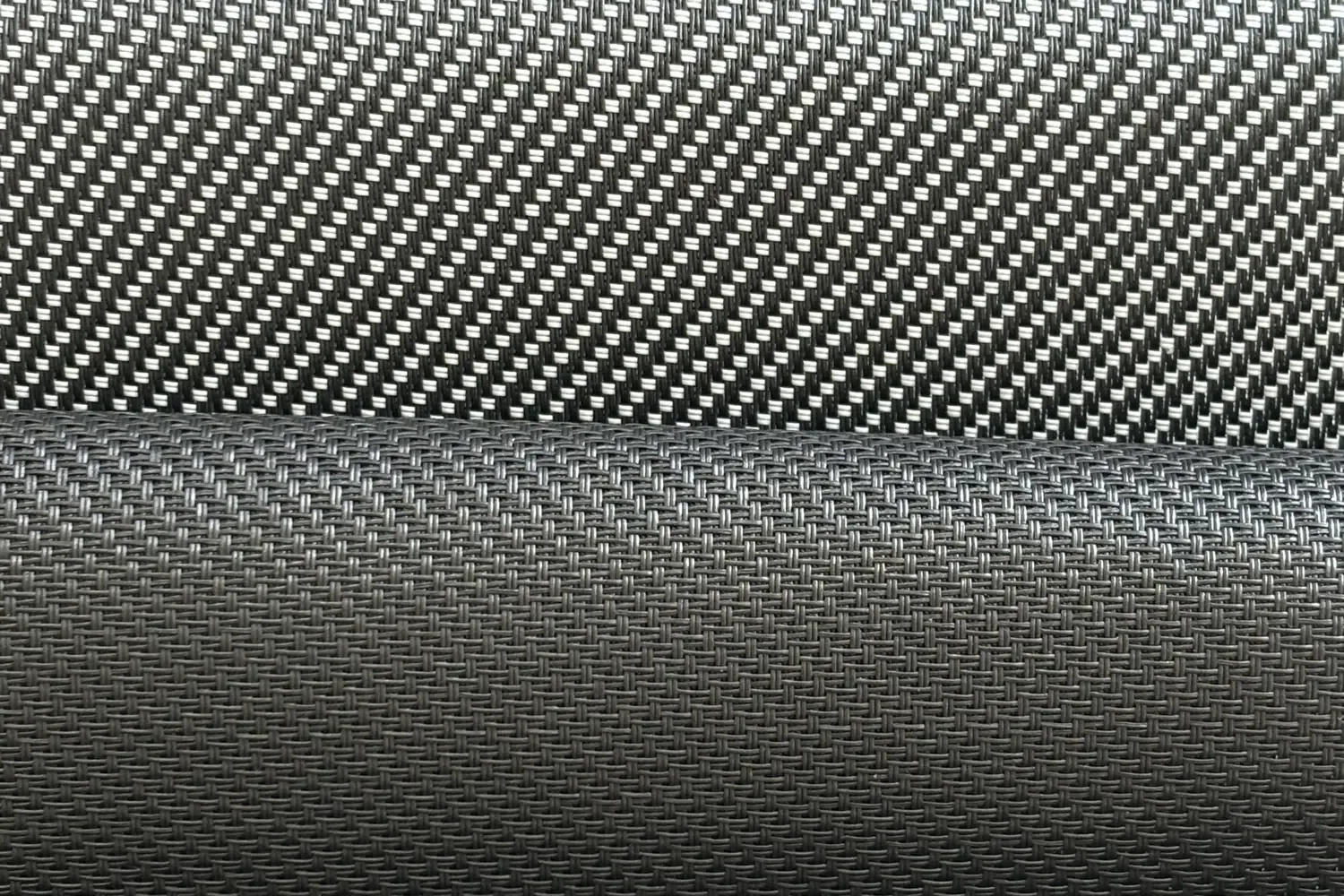
Large elevations are covered by several drops side by side, and the joins are what the eye sees. Width availability and colour consistency across batches decide whether the facade reads as one surface.
One facade, many drops
The seam is the design problem.
A facade is rarely one blind. It is a row of drops, and if the fabric is narrower than the bay, each drop needs a horizontal join. Those joins catch light differently from the weave and become visible as bands. Supplying the widest available roll in the same colour is the simplest way to avoid them, which is why we hold the full 3200 mm width across all 17 colours rather than only in a few.
Railroading
Rotating the fabric so the roll width runs horizontally avoids horizontal joins on wide bays.
Roll length
50 m at 1600 mm, 40 m at 2850 mm, 33 m at 3200 mm.
Colour
PVC is compounded in house, so colour is controlled batch by batch.
These three are settled at specification stage. Changing any of them after the roll is cut means remaking the order.
01 / Bay width1
Measure the widest bay first
The widest bay sets the roll width for the whole elevation. If it exceeds 3200 mm the bay needs a join, and the join position should be drawn into the elevation before ordering.