Buying Guides
Colour, Width and Roll Length Are One Specification, Not Three Line Items
Colour decides the series, the series decides the openness, and the minimum order is counted per colour. How to write a fabric specification that cannot be substituted.
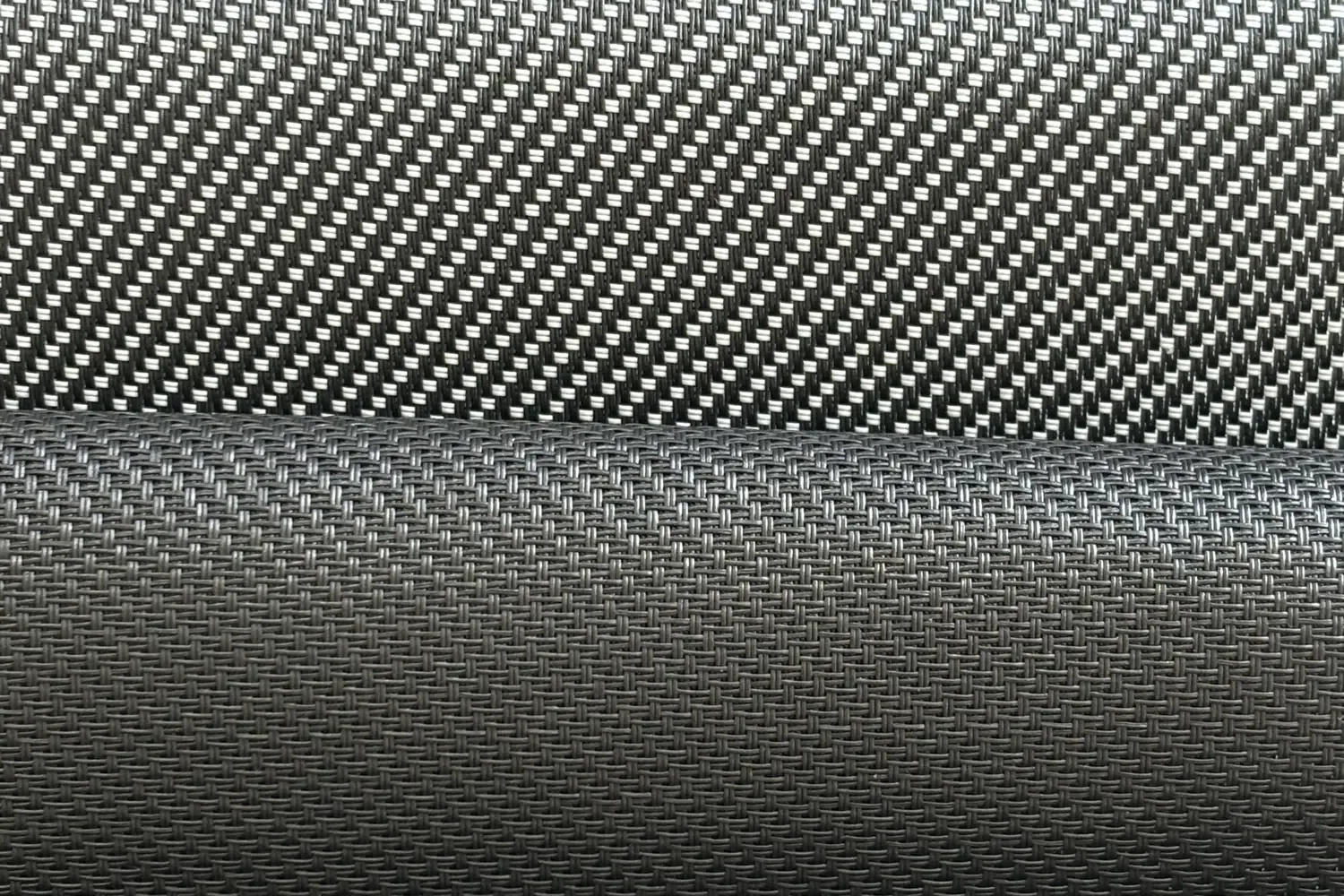
A fabricator sends a request with three lines: colour black 018018, width 2,500 mm, roll length 50 m. On a woven coated fabric those three lines are not independent options on a price list, even when the answer is yes to all of them.
The colour decides which series the project can use. The series decides the openness. The width decides how much fabric comes on a roll. And the minimum order is counted per colour, not per order — so the colour count sets the order size before the panel count does.
This article is about that chain and how to close it in one exchange instead of five. It covers the colour-to-series constraint, what the five widths mean for a colour choice, how the 1,000 m² minimum compounds across colours, and how lead time is counted.
For the measurement side — the three numbers you actually order, and how the opening becomes a fabric width — the measuring guide covers it: How to Measure for a Zip Screen Without Ordering the Wrong Width. This article assumes you already have a width to specify.
Key takeaways
- The colour decides the series, and the series decides the openness. The 3% series carries 17 colours; the 5% series carries 4. If a project starts from a colour, the openness is not a free choice.
- The five widths are available across the full colour list. 1,600, 1,900, 2,500, 2,850 and 3,200 mm can all be produced in every colour of both series, so the ideal width for a cut is not traded against the colour.
- The minimum is 1,000 m² per colour, not per order. A four-colour project carries a 4,000 m² minimum, and that arithmetic is better done before samples are requested.
- 1,000 m² is a different number of rolls at every width. About 13 rolls at 1,600 mm, about 10 at 3,200 mm — the same minimum is a different production run depending on the width.
- Lead time is 20–25 days from the confirmed order and the deposit. The starting point matters as much as the number; a quote measured from the enquiry date is a different promise.
Where these figures come from
Every number here comes from our published product specification for the 3% and 5% fabrics — weight, thickness, yarn count, weave density, widths, roll lengths and colour counts — plus our standard commercial terms for minimum order and lead time.
Nothing is estimated and nothing comes from a third party. Where a figure is a calculation rather than a published value, it is marked as calculated in the data notes at the end.
Why the three attributes are not independent
Think of the fabric as coming off two machines in sequence. The loom produces a greige web at a fixed width. The coating line takes that web, dips it, meters it, cures it and winds it into a roll. Each machine constrains the other, and the colour list sits across both.
Constraint | Effect on the buyer |
|---|---|
Colour range — set by the coating batch | A colour may exist in one series and not the other |
Available widths — set by the loom and slitting | You choose from a list, not a continuum |
Roll length at a width — set by the winder | The roll is a fixed volume, not a fixed length |
Minimum order — set per colour | Colour count multiplies the minimum, not the area |
The first row is the one this article is about, and it is the one least often checked. Buyers tend to start from the openness they want and then look for a colour. The constraint runs the other way.
The third row — how roll length changes with width — is covered in the measuring guide, including the roll length that comes with each of the five widths. It is not repeated here.
The colour range is not the same in both series
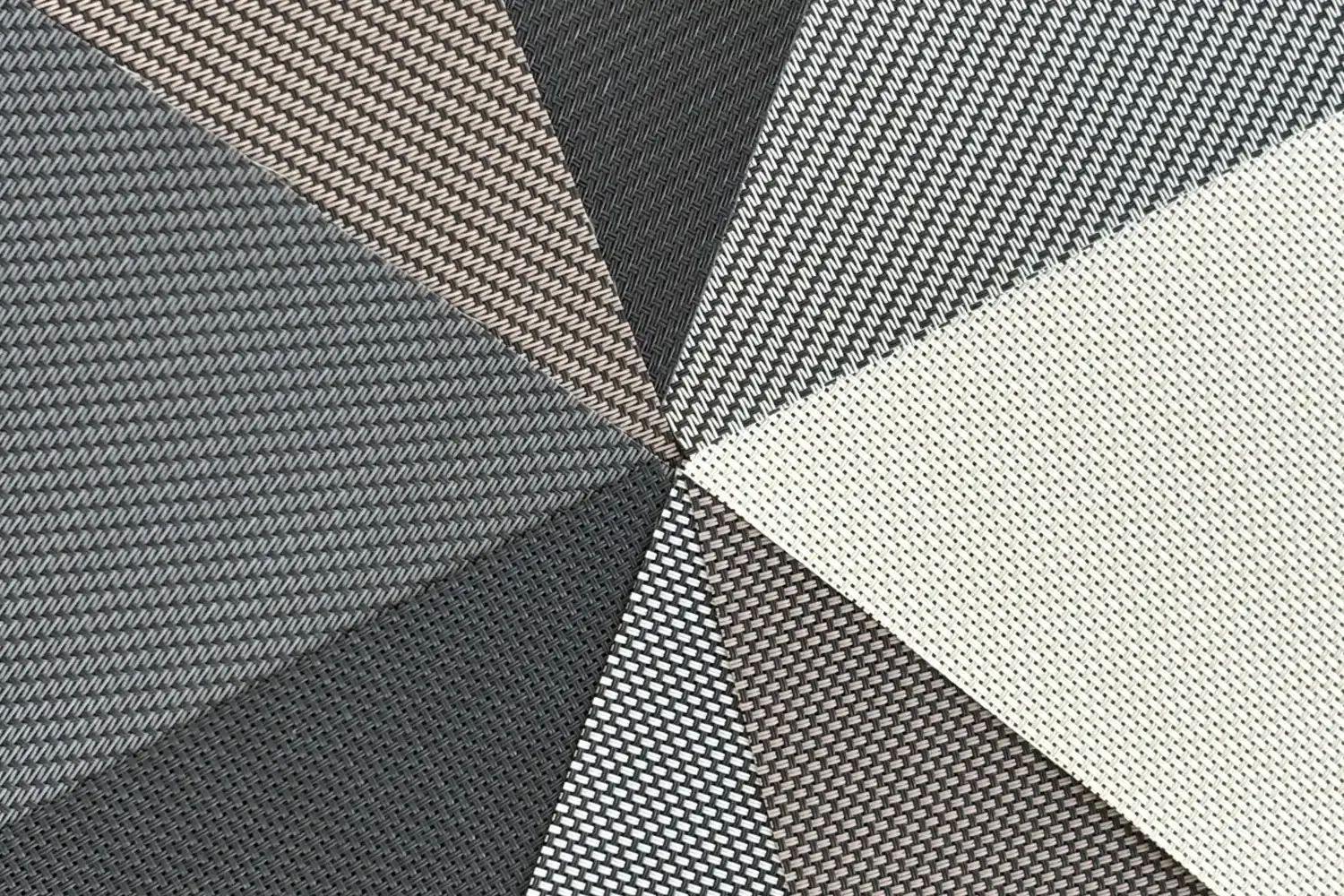
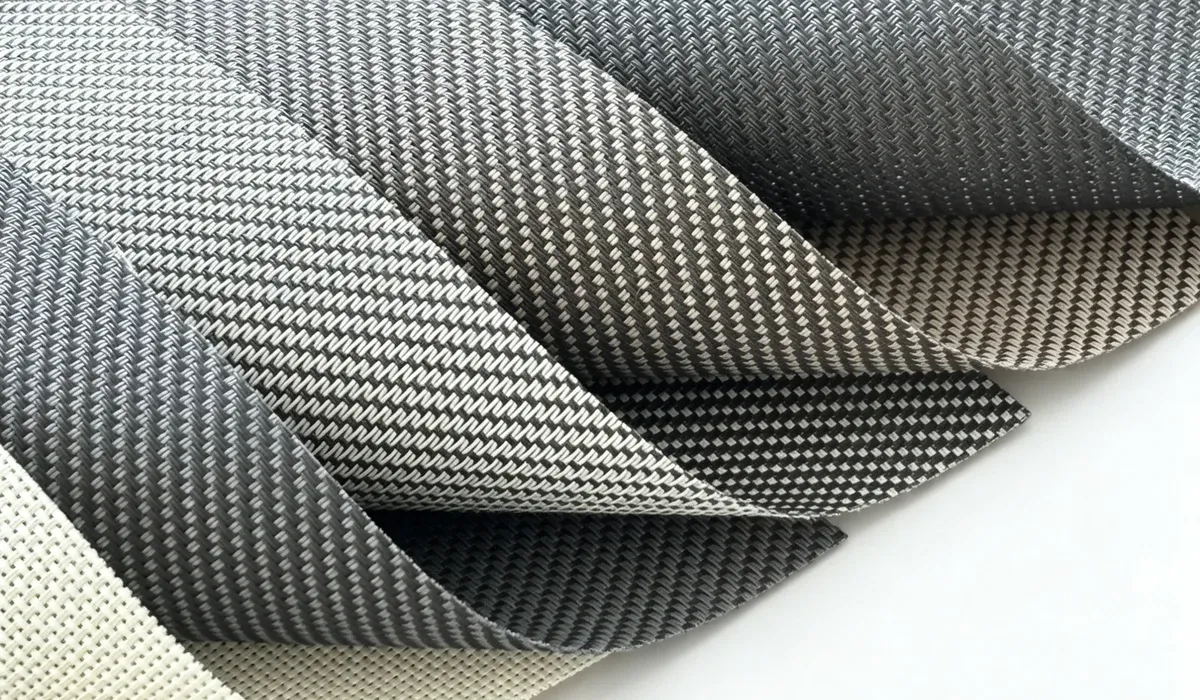
The two series share construction, yarn, weave density, weight and thickness. They differ in openness and in how many colours are held.
Property | 3% series → 5% series |
|---|---|
Openness | 3% → 5% |
Colours | 17 → 4 |
Weight | 544 g/m² ±10, both series |
Thickness | 0.73 mm, both series |
Composition | Fibreglass 42% / PVC 58%, both series |
Yarn | 165 tex, both series |
Weave density | 45.5 × 35.5 yarns/inch, both series |
Widths | the same five, both series |
Seventeen colours in the 3% series, four in the 5%. That asymmetry is deliberate: 3% is the standard construction and carries the full colour range, while 5% is the more open weave held in a shorter list.
The practical consequence is a hard limit on any project that starts from a colour. If the colour is a project requirement and it only exists in the 3% series, the 5% series is not an option, regardless of the openness the project wanted. The colour decides the series, and the series decides the openness — the reverse of how most specifications are written.
That is worth testing early. Before a colour is approved by a client, it is worth asking one question: does this colour exist in the openness we need? A colour approved against the wrong series is a design change, not a substitution.
All five widths can be made in every colour
In a lot of fabric ranges, the widest width exists only in a handful of colours, because wide rolls are expensive to stock. A buyer then discovers that the ideal width for the cut does not exist in the specified colour, and either accepts a wider roll (more offcut) or changes colour.
In our range that constraint is absent: all five widths can be produced in every colour of both series. A project can have the widest roll and any colour without trading one against the other.
That changes what a buyer should ask. With most suppliers the question is "which widths do you hold in this colour". With us the question is "what does the minimum look like at the width I need", which is a shorter conversation.
The distinction between can be produced and is held in stock matters, and it is worth being precise about it. We are not claiming that every colour sits in a warehouse at every width. Production is scheduled against the order; the point is that the order is not refused because of a colour and width mismatch.
What happens when the three are specified separately
The failure is predictable. A buyer sends three independent line items. The supplier checks each one for existence, finds two, and proposes the nearest available for the third. The proposal is technically correct and commercially wrong, because the change moves a cost the buyer has not priced.
What changes | What it costs |
|---|---|
Colour substituted | A design decision made by the supplier, not the project |
Series changed to reach a colour | The openness changes, which changes light and view |
Colour count increased | The minimum order multiplies by the number of colours |
Width widened for scheduling | Offcut per drop rises; material efficiency falls |
None of those is a defect. Each is the correct answer to an incomplete question. The fix is not to negotiate harder; it is to send the constraint rather than the wish list.
The minimum is counted per colour
This is the number that decides whether a multi-colour project is viable, and it is usually read too quickly.
The minimum is 1,000 m² per colour. It is square metres, not metres, and it is per colour, not per order. A four-colour project does not have a 1,000 m² minimum; it has a 4,000 m² minimum, split across four colours.
Colour count | Total minimum |
|---|---|
1 colour | 1,000 m² |
2 colours | 2,000 m² |
3 colours | 3,000 m² |
4 colours | 4,000 m² |
The width then changes what the minimum means in production. Because the roll is a fixed volume, 1,000 m² is a different number of rolls at every width:
At this width | 1,000 m² is about |
|---|---|
1,600 mm | 625 m, about 13 rolls |
1,900 mm | 526 m |
2,500 mm | 400 m |
2,850 mm | 351 m, about 9 rolls |
3,200 mm | 312 m, about 10 rolls |
The last column is the one that matters for scheduling. At 1,600 mm the minimum is thirteen 50 m rolls; at 3,200 mm it is ten 33 m rolls. Same 1,000 m², different run, different core count, different handling and different freight.
That is also why a colour-heavy project should be costed before samples are ordered. Four colours at 1,000 m² each is a 4,000 m² production programme, and it should be planned as one, not discovered after the first colour is approved.
Lead time counts from the deposit
Lead time is 20–25 days, counted from the confirmed order and the deposit. The starting point matters as much as the number. A quote measured from the enquiry date and a quote measured from the deposit are not the same promise, and the second is the one a production plan can keep.
That distinction is what makes lead time comparable between suppliers at all. A mill holding an allocation queue may quote a shorter production window but a longer queue. A mill that quotes 20–25 days from deposit may still deliver sooner, provided the specification and the deposit are settled early.
The comparison to make is the date the fabric leaves the plant, not the number of days in the slogan. If two suppliers quote 20 and 25 days but one starts counting at enquiry and the other at deposit, the numbers are not on the same scale.
How to write the specification as one line
A specification that cannot be substituted reads like this:
3% openness, black 018018, 3,200 mm, 33 m rolls, 14 rolls, for panels 2,400 × 2,600 mm finished.
Five things are in that line: the series, the colour reference, the width, the roll length and the panel size the fabric is for. With those five a supplier can confirm availability without guessing, and can say no immediately if one element does not exist.
Compare it with the version that causes the problem:
Black fabric, 2.5 m wide, 50 m rolls.
That version cannot be answered accurately. It does not say which series, the colour reference is missing, and the panel size — the only number that explains why the width was chosen — is absent.
Four inputs do most of the work:
- Colour reference, not a colour name. Our references are four-digit codes; a name like "sand" exists in several codes.
- Series, 3% or 5%, because the colour range differs between them.
- Width, with the panel size it is for, so the width can be checked against the cut rather than against a preference.
- Roll length, or an explicit statement that the standard length at that width is acceptable.
Packing, loading and delivery follow from those four.
Our take
The most useful question a buyer can ask is not "what is your price per square metre" but "does this colour exist in the openness I need, and what does the minimum look like at this width". Those two questions expose the constraints that actually decide the order, and both are answerable in one line.
The habit worth building is to write the specification as a constraint rather than a list. A list invites substitutions; a constraint forces a yes or a no. And a no, early, is worth more than a substitute discovered at the cutting table.
The third thing is arithmetic on the colour count. A four-colour order is four minimum orders. That is easy to say and easy to forget when the samples are being chosen.
Three things to do before sending the next enquiry
- Check the colour against the series, not the other way round. Ask whether the colour exists in the openness you need before the client approves it.
- Count the colours against the minimum. 1,000 m² per colour, so the colour count sets the order size before the panel count does.
- Compare lead times from the same starting point. Deposit, not enquiry. Otherwise two quotes are not on the same scale.
Sources
- [S1] Orenda 3% openness fabric specification — 17 colours, 544 g/m² ±10, 0.73 mm, 165 tex, 45.5 × 35.5 yarns/inch, five widths. https://www.orendascreen.com/products/3-percent-openness-fiberglass-sunscreen-fabric
- [S2] Orenda 5% openness fabric specification — 4 colours, same construction, same widths. https://www.orendascreen.com/products/5-percent-openness-fiberglass-sunscreen-fabric
- [S3] Orenda colour range, 17 colours in the 3% series. https://www.orendascreen.com/colours
- [S4] Orenda commercial terms — minimum order 1,000 m² per colour; lead time 20–25 days after confirmed order and deposit. Internal commercial record, authorised for publication 2026-11-10.
- [S5] Orenda, How to Measure for a Zip Screen Without Ordering the Wrong Width — the measuring sequence, and the roll length that comes with each width. https://www.orendascreen.com/posts/how-to-measure-for-a-zip-screen
No third-party data is used in this article.
What we do not claim
- We do not publish price, payment terms or stock levels. Those are quoted per project.
- The minimum order and lead time are standard values. A specific project is quoted individually, and a change in colour count, width or roll length can change both.
- We do not claim that every colour is held in stock at every width at all times. All five widths can be produced in every colour; production is scheduled against the order.
- We do not restate roll lengths per width in this article. They are in the measuring guide.
- We do not state a warranty term or a service life.
- We do not compare our range numerically with any other manufacturer.
Data notes
Figure | Value · source · type |
|---|---|
Colours | 17 in 3%, 4 in 5% — [S1] [S3], stated |
Weight | 544 g/m² ±10, both series — [S1] [S2], stated |
Thickness | 0.73 mm, both series — [S1] [S2], stated |
Composition | Fibreglass 42% / PVC 58% — [S1], stated |
Yarn | 165 tex — [S1], stated |
Weave density | 45.5 × 35.5 yarns/inch — [S1], stated |
Widths | 1,600 / 1,900 / 2,500 / 2,850 / 3,200 mm — [S1], stated |
All five widths in every colour | yes, both series — [S1] [S2], stated |
Minimum order | 1,000 m² per colour — [S4], stated |
Minimum, 2 / 3 / 4 colours | 2,000 / 3,000 / 4,000 m² — calculated, 1,000 × n |
1,000 m² at 1,600 mm | 625 m, about 13 rolls — calculated, 1,000 ÷ 1.6; 625 ÷ 50 |
1,000 m² at 1,900 mm | 526 m — calculated, 1,000 ÷ 1.9 |
1,000 m² at 2,500 mm | 400 m — calculated, 1,000 ÷ 2.5 |
1,000 m² at 2,850 mm | 351 m, about 9 rolls — calculated, 1,000 ÷ 2.85; 351 ÷ 40 |
1,000 m² at 3,200 mm | 312 m, about 10 rolls — calculated, 1,000 ÷ 3.2; 312 ÷ 33 |
Lead time | 20–25 days from confirmed order and deposit — [S4], stated |
Roll length by width | not restated here — see [S5] |