Fabric Knowledge
Why Screen Fabric Curls at the Edge
A curl is a disagreement between the two faces of a fabric. Where the yarn sits in the coating decides how much each face can move, and how to test it in 24 hours.
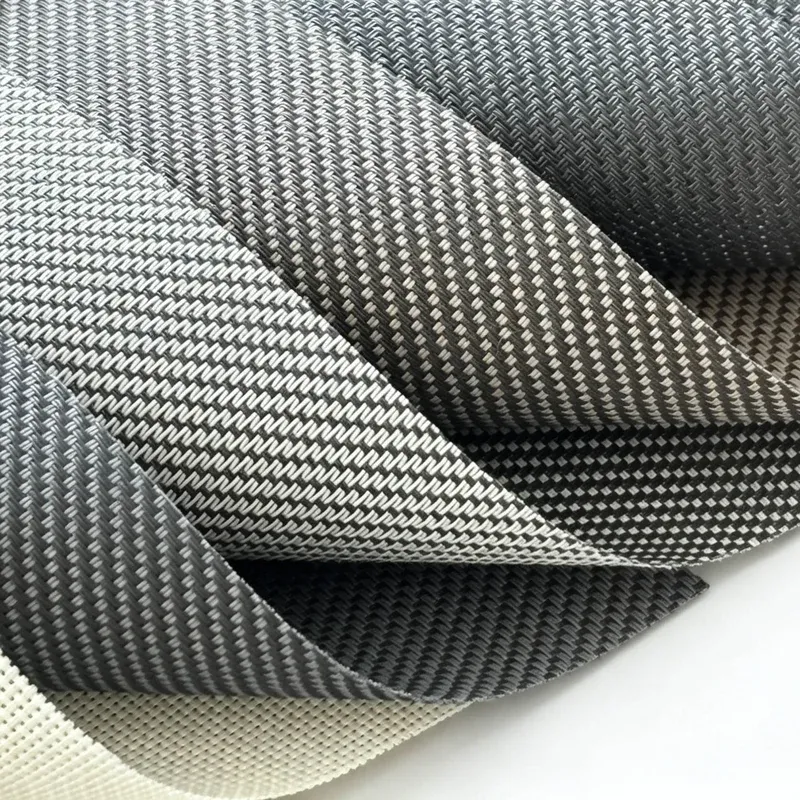
A panel that hung flat at installation starts to wave along one edge after a season. The fabric is not torn, the colour has not changed, and the frame has not moved. What has changed is the balance between the two faces of the fabric.
Curl is one of the few defects that customers describe precisely and diagnose wrongly. The usual explanation is "the fabric is too thin" or "the coating is poor". Both miss the mechanism. A curl exists because one face of the fabric is trying to be a different size from the other face — because the two faces differ in coating thickness, in tension history, or in how much moisture and heat they have absorbed.
This article explains where that asymmetry comes from, why the position of the fibreglass yarn inside the coating matters, what a 24-hour bench test can tell you, and why a curl that appears after a season is a different problem from one that is there on delivery.
Key takeaways
- Curl is a difference between two faces, not a fault in one face. If both faces were identical in thickness, tension history and moisture content, the fabric would lie flat.
- The yarn's position inside the coating sets how much asymmetry the fabric can tolerate. A yarn sitting off-centre leaves one face with less coating and less protection than the other.
- Dip coating and extrusion coating place the polymer differently. Dipping brings PVC into the yarn bundle from both sides; extrusion lays melt onto the surface, so centring depends on die alignment and yarn tension.
- The bench test is 100 mm, 24 hours, four corners. Cut a square, lay it on a flat plate at room conditions, measure corner lift in millimetres.
- A curl that appears after a season is a creep symptom, not a delivery defect. It has to be tested by cycling, not by inspecting a fresh roll.
Method and sources
Three inputs, all first-party or mechanical:
- Process description. How our two coating routes place polymer around a fibreglass yarn, from our own production engineering.
- A bench protocol. The 100 mm square test described below is a workshop method, not a standard. It is useful for comparison between samples; it is not a substitute for a dimensional-stability test under a recognised standard.
- Field reports. Edge curl described by fabricators after one or more seasons in service, reported to us in 2026.
There are no laboratory results in this article. We have not measured curl on our own fabric under a controlled standard, so no curl figure appears here. Where the mechanism is a reasoned explanation rather than a measurement, it is described as such.
A curl is a disagreement between the two faces
Take a strip of coated fabric and imagine each face as a separate sheet. If one sheet wants to be 1 mm longer than the other, the pair cannot both lie flat: one has to curve. The radius of that curve depends on the difference in length, not on the absolute length.
Three things create that difference:
Source of asymmetry | What it does |
|---|---|
Coating thickness differs face to face | The thicker face shrinks more on cooling and curing, and absorbs less moisture later |
Tension history differs across the width | One edge is stretched more than the other during coating or post-treatment, and remembers it |
One face sees more heat or moisture | A face that has absorbed moisture swells; a face that has been over-cured is stiffer and shorter |
The practical point is that a curl is a balance problem, so it can be caused by any of the three, and it can also be cured by an opposite imbalance. That is why some curls disappear when a panel is hung under tension: the system's tension is large enough to flatten the difference. It is also why a curl that appears only at the free edge of an unloaded panel is a different severity from one that distorts a tensioned zip screen.
Where the yarn sits decides how much each face can move
A coated woven fabric is a grid of yarn bundles, each bundle encapsulated in polymer. The geometry of that encapsulation is what determines how the two faces behave.
If the yarn sits centrally, the coating thickness above and below it is roughly equal. Both faces have similar polymer mass, similar barrier properties and similar shrinkage. The fabric is balanced by construction.
If the yarn sits off-centre, one face has a thin coating skin and the other has a thick one. Three consequences follow, in increasing order of seriousness:
- Appearance. The thin face can show the weave more strongly, and can look slightly different in colour at grazing angles.
- Mechanical. The thin face has less polymer between the yarn and the environment, so abrasion and flexing reach the yarn sooner.
- Dimensional. The thick face shrinks more and absorbs less, so the two faces move differently over time. This is where curl comes from.
Centring is therefore not a cosmetic detail. It is the property that makes the other properties predictable.
Dip coating and extrusion coating put the polymer in different places
The two common ways to coat a woven fibreglass are structurally different, and the difference matters for centring.
Dip coating. The woven web passes through a PVC plastisol bath, then through metering to control pick-up, then through an oven to fuse the coating. Because the web is immersed, polymer enters the openings between yarns and penetrates the individual fibre bundles from both sides. The yarn ends up embedded in polymer rather than sitting under it. Centring is a consequence of the immersion and the metering, so the process is relatively tolerant of small tension variations.
Extrusion coating. A molten polymer film is laid onto one or both faces from a die, then nipped against the web. The polymer builds up on the surface. How evenly it wraps around the yarn depends on the die's alignment with the web, the nip pressure and the yarn tension. When those are right, the result can be excellent. When they drift, one face receives more polymer than the other, and the fabric is born asymmetric.
Aspect | Dip coating → Extrusion coating |
|---|---|
How polymer reaches the yarn | Immersion, then metering → laid on the surface from a die |
Where the polymer ends up | Inside and around the bundle → mainly around the outside |
Centring depends on | Immersion plus metering → die alignment, nip, yarn tension |
Typical failure if control drifts | Pick-up variation along the length → face-to-face thickness difference |
This is the point where most supplier comparisons go wrong, in both directions. It is not true that extrusion coating always produces an off-centre yarn — a well-controlled line can hold it. It is true that dip coating centres the yarn as a consequence of the process rather than as a result of a setting that has to be maintained. One is a design property; the other is a control property.
Our own route is dip coating, and the sentence we would stand behind is narrow: PVC penetrates each individual fibreglass yarn. That is a statement about construction, and it is the reason the yarn sits inside the coating rather than under it.
The bench test: 100 mm, 24 hours, four corners
You do not need an instrument to compare two samples, but you do need a fixed procedure, otherwise the numbers are not comparable.
- Cut a 100 × 100 mm square from the middle of the roll, not from the edge, and not from the first metre.
- Condition it flat on a clean glass or steel plate at room conditions for 24 hours, with nothing on top.
- Measure the lift at each corner with a steel rule, in millimetres, with the square resting on the plate.
- Repeat on three samples from the same roll, and on three from a second roll. Record the range, not just the average.
- Note the direction of curl relative to the warp. A curl that is symmetric about the warp and the weft is a thickness problem; a curl that is asymmetric suggests a tension problem.
A single square tells you very little. Three squares from two rolls tell you whether the fabric is balanced and whether it is consistent. That is the comparison that matters when you are choosing between suppliers.
For a panel that has already been in service, the same test can be run on a cut-out, with one change: condition it for 24 hours in each orientation (face up, then face down) and note whether the curl reverses. A curl that reverses is a moisture imbalance and will move with the seasons. A curl that does not reverse is a built-in thickness or tension difference.
What we do not publish: a curl figure for our fabric. The test above is our workshop method, not a standardised dimensional-stability test, and we have not run it as a controlled study. If a project needs a number, it has to be measured on the actual fabric and colour.
Why the curl appears after a season, not on delivery
A fresh roll can be perfectly flat and still produce a wavy panel a year later. This is not a contradiction; it is creep.
Coated fabric is a composite of stiff fibres and a viscoelastic polymer. Under sustained tension, the polymer relaxes and the composite takes up a slightly different length. If the two faces differ in coating thickness, they relax at different rates, and the difference accumulates. The same happens with moisture cycling: a face that absorbs and desorbs water repeatedly will not return exactly to its original length.
Three field patterns follow, and they point to different causes:
Pattern | Likely mechanism, and what to test |
|---|---|
Curl present on delivery, before hanging | Built-in thickness or tension asymmetry. Test with the 100 mm square on a fresh sample |
Flat on delivery, curls within weeks of hanging | Tension distribution in the system, not the fabric. Check panel tension and side guide, then retest the fabric |
Flat for a season, then waves | Creep plus moisture cycling. Cycle the conditioning, then reverse the square and compare |
The middle row is the one most often blamed on the fabric and least often caused by it. A zip screen holds its panel under tension between two side guides. If that tension is uneven — one guide tighter, one hem slightly short — the panel will curl regardless of what the fabric does. It is worth ruling out the system before opening a material claim, because a replacement roll will do the same thing.
What actually holds a panel flat
Fabric balance is necessary and not sufficient. Three system factors decide whether a balanced fabric stays flat in service:
- Tension distribution. A zip screen relies on even tension across the width. Uneven tension produces a curl that looks exactly like a fabric fault.
- Allowance at the edges. The hem or weld takes up material; if the take-up differs between the two sides, the panel is asymmetric before it is even hung.
- Support spacing. A wide panel with insufficient intermediate support sags, and sag reads as curl at the free edge.
That is why our recommendation is to test the fabric and the system separately before replacing either. It is also why we ask for the panel dimensions and the system type when a curl complaint arrives: without them, the fabric is the only variable anyone can see, which makes it the default suspect.
Our take
Curl is a useful complaint because it is measurable and it is caused by something structural. A 100 mm square, 24 hours and a steel rule will tell you whether the problem is built into the fabric or introduced by the system, and that answer is worth more than a replacement roll.
Where the yarn sits inside the coating is the part of the mechanism that buyers rarely ask about, and it is the part that decides whether the fabric can stay balanced as it ages. A centred yarn gives both faces a similar amount of polymer to shrink and swell with. An off-centre yarn gives one face less to work with, and the difference shows up later, when the panel is already on a building.
Three things to do before the next order
- Run the 100 mm test on three samples from two rolls. Compare the range, not the average, and compare two suppliers on the same day.
- Ask how the yarn is centred, and ask for a cross-section. A micrograph of a cut edge at 200× answers the question in one image; a specification sheet does not.
- Rule out the system before claiming the fabric. Check panel tension, guide alignment and hem allowance. If the panel is unevenly tensioned, no fabric will hang flat.
Sources
- [S1] Orenda production engineering — dip coating route, polymer penetration of the yarn bundle, metering and centring. Internal, 2026.
- [S2] Orenda field reports — edge curl reported by fabricators after one or more seasons, 2026. Internal.
No third-party data is used in this article.
What we do not claim
- We do not publish a curl measurement, a flatness tolerance or a dimensional-stability figure for our fabric. Those tests have not been run as a controlled study.
- The 100 mm protocol is a workshop comparison method, not a standardised test. Results are comparable between samples measured the same way, and not otherwise.
- We do not claim that dip coating eliminates curl. It centres the yarn by construction; the system can still introduce curl.
- We do not state a service life or a warranty term.
- We do not name or compare any other manufacturer's process or product.
Data notes
Figure | Value · source · type |
|---|---|
Test square | 100 × 100 mm — [S2], protocol |
Conditioning time | 24 hours, room conditions — [S2], protocol |
Samples per comparison | 3 per roll, 2 rolls — [S2], protocol |
Inner paper tube (packing) | 76 mm bore, 6 mm wall — packing specification, stated |
Coating route | Dip coating; PVC penetrates each yarn — [S1], stated |
Curl figure for Orenda fabric | none published — not tested |